|

Newsletter
16/ March 2009
|
|
|
April 4, 2009
The expedition reached Nova Scotia last weekend. Halifax is the journey’s last North American stopover. The crew, who had caught up with winter very suddenly off Cape Hatteras, now has met up with snow. The loch already reads 18,032 nautical miles, and there is still an ocean to cross over before we reach Tromsø, “Southern Star”’s home port and the point of departure of the expedition. Hence, by the time we get there, we will have fallen far over the 18,000 miles modestly announced by Olivier Pitras, the expedition chief, in Spring 2007.
|
|
|
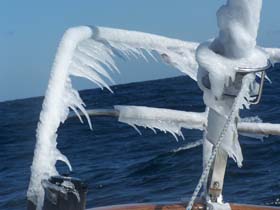
A little before New York, the cold was back on board. Freezing spray had accumulated on the sailboat’s structures. A great deal of ice is coming down Cabot Straight at this time, and the Banks of Newfoundland are stacked with sea ice. As a consequence, the road to Iceland will probably begin with a great swoop to the southeast before we’ll be able to head toward the Great North. Such a high proportion of ice on the Banks in this season is unusual, according to the Canadian Ice Service. A scrutiny of the maps concerning “variations of concentration with respect to the norm” clearly indicates that ice that previously showed up at this time of year higher up north, around Belle Isle, is now to be encountered further south on the Banks of Newfoundland.
|
At the time of writing, the crew is getting ready for departure. We are wishing all onboard well for this big leg of the journey. The North Atlantic in April doesn’t have a particularly good reputation.
|
|
Stopovers :
The expedition’s New York stopover was the chance to tackle the economic and political aspects climate change. The crew thus ascertained that “green business” constitutes an important part of tomorrow’s economy. The American financial world, in spite of the current worldwide crisis, is very open to green initiatives. Experts even see in these a solution, among others, to help us out of the crisis. Without a doubt, industry and finance are increasingly integrating the parameter that is climate change. |
The crew also met, at the United Nations, the man who is charge of the Copenhagen Summit. Janos Pasztor, Director of “Management Group for the Environment”, works tirelessly together with his team on the next summit in Copenhagen, hoping that this international meeting on the environment will be the starting point for concrete measures on the part of governments of the international community. All are conscious that it is imperative to act quickly from now on, but concrete actions are slow to come. The U.S., with the support of the Obama administration, intends to play a leading role in fighting climate change. This is obviously a position that is diametrically opposed to that held by Bush. We hope the new American president will be able to convince members of the Congress and will have the means to set up his ambitious campaign in favor of the environment.
|

Janos PASZTOR
|
Southern Star reached Newport after peaceful sailing through Long Island Sound, protected from the offshore swell. The Newport Yacht Club hosted the expedition there. The dynamic of the oceans and paleoclimatology stood at the heart of this stopover. The analysis of marine sediment logs allows one to look back 65 million years, whereas ice logs only offer a jump back 800,000 years. Experts are firm on this: never, on the stretch of time thus studied, have climate alterations occurred in so rapid a succession as the one we are living today. Analyses have also led to the detection of two great major periods, outside the short cycles of climate change. The first of these major periods stretches from 65 to 35 millions years. This was a “warm” period and it was followed by a “cold” period, from 35 millions years to today.
|
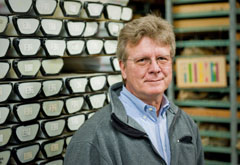
Dr. William B. CURRY
|
|
Leaving Newport, Southern Star left American waters for Canadian waters. Fishing was the topic of the stopover in Nova Scotia. First the Fisheries and Oceans Canada administration, then experts from of the universities of Saint Mary and Dalhousie enlightened expedition crew members as to the current situation of stocks. The crisis around cod spawned the development of spiny lobster fishing in order to save the local economy, but experts all concur: fishing as we practice it today cannot last and we must review our fishing methods, probably by encouraging coastal fishing rather that offshore factory boats and developing aquaculture for non carnivorous species.
|
|
Film, documentaries, exhibits, conferences… briefly
The first 52-minute documentary of the expedition (from Tromsø to Disko Bay in Greenland) will be aired on Planet Thalassa on June 17, and the second episode (from Disko Bay to Dutch Harbor, i.e. the Northwest Passage) will be aired one week later, on June 24, 2009. The numerisation of episode 3 is nearly completed. Editing should begin at the end of May.
|
The production crew is currently looking for a co-producer for the 90-minute feature retracing the entire journey. Contacts were made in Canada, where productions are accustomed to work in partnership. The crew is open to all propositions.
Olivier Pitras will be in France in the first half of June. During this time, and just before setting off for another Arctic campaign in the Spitzberg, he will call on Bruno Philippe (manager of pedagogical programs) and his class and will answer questions from the media
|
|
|
A conference series is in the works, to be scheduled in the fall or winter of 2009 in the North American stopover cities: Vancouver, San Francisco, Acapulco, Miami, New York, Newport and Halifax.
The municipality of Tromsø has kindly offered use of an auditorium for a conference on the day of the expedition’s arrival home.
A photo exhibit, highlighting the great moments of the expedition will be up from May 16 to 23 in the lobby of Tromsø City Hall. Two additional exhibits, at Polaria and at the University of Tromsø, are scheduled, dates to be announced.
Voiles & Voiliers magazine should feature a full article about the expedition in its June or July 2009 issue.
|
|
|
| |
Copyright
Text & Pictures: Olivier Pitras (except other mentions)
|
|